Opinion
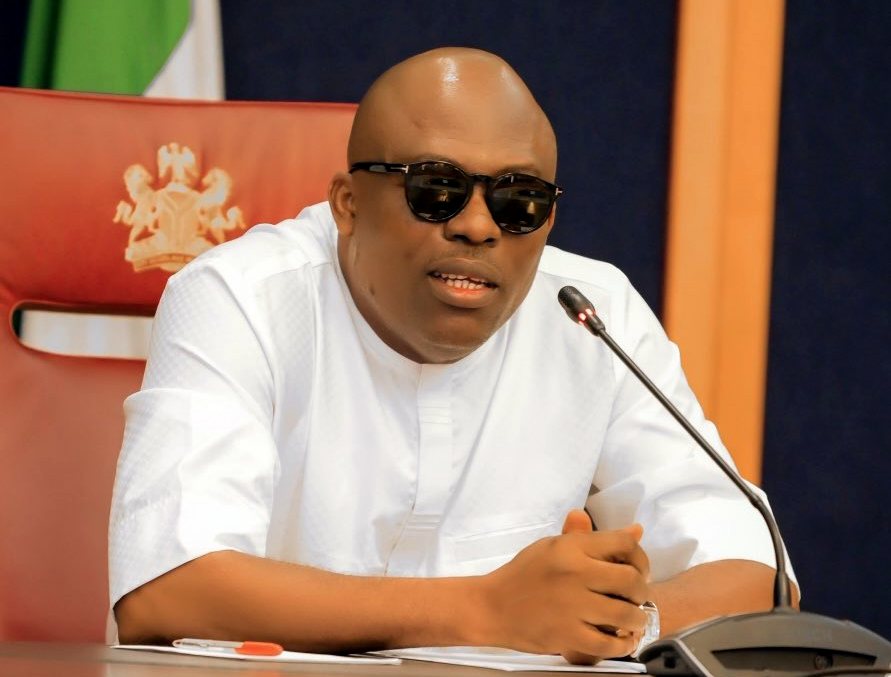
Fubara: Go, going…
Published
7 months agoon

The Rivers godfatherism crisis highlights tensions between political patrons and protégés as governance, legality and stability come under strain
A one-time presidential aspirant in the United States was asked, if he loses the primaries, whether he would accept to be the running mate to the victor, but he quipped: “I hate all vices, including the vice-president!”
Also read: Rivers APC Defends Fubara, Calls Off Impeachment Threat
I, too, hate all vices, the vices of godfathers and godsons inclusive! We should not condemn one without condemning the other since both are two sides of the same coin.
In the Nigerian political system of today, it is a kind of willing seller and willing buyer market.
In a similar fashion, when we condemn vote-buying, we must also not forget to condemn vote-selling.
There can be no vote-buying if there are no willing vote-sellers.
It fits perfectly what economists call the law of demand and supply.
Both legs must stand before the law can work.
I am not unmindful, though, of the argument that one can be a victim of the other, but victimhood should not totally absolve anyone of blame if we admit that everyone has a responsibility, and duty, to act as an agent of change if we are to stand any chance of building a just and egalitarian society.
The victim, like Karl Marx posits in the opening words of The Communist Manifesto, must understand that he has nothing but his chains to lose. He has a duty, and a price to pay, if he must move in that direction. Otherwise…
Nothing exists that does not serve a function or purpose; otherwise, it would not exist in the first place.
Look around and see if you can find one such thing that is not serving this or that purpose and for this or that person.
What you abhor or adjure is what someone else embraces and enjoys.
When governments were pulling no stops to wipe out marijuana use was when Peter Tosh sang “Legalize it, and I will advertise it!”
Some political theorists posit that even corruption exists to perform some (inescapable) functions; otherwise, there would be no corruption.
How many traffic offenders in Lagos state, for instance, will choose to go the way of the law and have their vehicle impounded, go for psychiatric test, and then pay a whopping some of money when they can easily part with a paltry sum as bribe and go their way?
So, when prescribed penalties for minor offences are stiff, we inadvertently create loopholes for law enforcement agents to exploit, not to enrich the State but for their own selfish benefits.
I have heard people quote Jesus Christ (specifically in Matthew 5:25 – 26 and Luke 12:58) to kind of support this; akin to how Antonio, William Shakespeare’s character in The Merchant of Venice (Act 1, Scene 3), described Shylock as “an evil soul producing holy witness”
And Jesus said: “Agree with thine adversary quickly, whiles thou art in the way with him; lest at any time the adversary deliver thee to the judge, and the judge deliver thee to the officer, and thou be cast into prison.
Verily I say unto thee, Thou shalt by no means come out thence, till thou has paid the uttermost farthing.” (Matthew 5: 25 – 26, King James Version). Oh-ooo! So who does that?
Most godfathers are taken in by the deceit of their godsons; it is impossible to believe that anyone will back another person for high office if he knew he would be stabbed in the back afterwards.
Many godsons are like Shylock, in Shakespeare’s work quoted above, who use “piety for deceitful purposes”.
And like Anthonio warned his friend Bassanio concerning Shylock, they are “much like rotten apples with a goodly outside.”
I doubt if Nyesom Wike would have supported Siminalayi Fubara if he knew that what he has turned out to be is the kind of person the Rivers state governor is!
Is there anything good with godfathers insisting on choosing their successors? The answer is both “Yes” and “No.”
Yes, because this is a practice not limited or restricted to politics; even in the private sector, it is widely practised.
In social clubs, alma mater organisations, it is the same thing.
Successors are selected well before time and are groomed to take office; and this is well-known to everyone.
To ensure continuity.
To ensure that the right hands are those allowed to take over.
Sometimes if you allow for so-called level-playing ground, the best candidate may not emerge.
As Jesus Christ again said in Luke 16: 8: “And the lord commended the unjust steward, because he had done wisely: for the children of this world are in their generation wiser than the children of light.” (King James Version).
Why is this so? According to a preacher, it is because the children of this world “are most times more intentional.”
While the children of light are still prevaricating and counting the cost, their wordly counterparts would have quickly made up their mind and seized the initiative.
Before anyone could say “Jack Robinson”, they would have grabbed it, snatched it, and run with it! Does that sound familiar?
So, if the purpose of godfatherism is to ensure continuity, prevent the unworthy from grabbing, snatching, and running with it, so as to ensure that good governance and the dividends of democracy percolate the polity, then, it can be looked upon with favourable eyes.
But even at that, a pool of the best candidates must be allowed to contest and contend. And the process must be transparent, fair and just.
Let it not be a one-man decision or an imposition. Worse, it must not be the imposition of someone who cannot emerge as one of the best in a free and fair contest.
And the purpose must not be for godson to cover the odious tracts of godfather or pander to his vainglorious wishes in such a way that the very purpose of good governance itself will be defeated.
In other words, godfatherism becomes an aberration and an anathema where the best candidate does not emerge; where it is an imposition; where the objective or goal is not continuity for good governance but pandering to the wishes of the godfather, good or bad; and where the interests of the governed are meant to take the back seat, if any at all.
The problem of most godfather-godson relationships in Nigeria the Rivers State example inclusive is that they fail most or all of the litmus tests stated above.
So, the blame must be spread evenly across godfathers and godsons.
A man who, with eyes wide open, climbs the back of a tiger only to think of disembarking on his own terms without considering the consequences cannot, in my view, be reckoned with as a man of wisdom or integrity.
Agreement is agreement, they say, and even among thieves there is nobility.
In my opinion, Fubara knew and planned from Day One not to honour whatever agreement he was entering into with Wike; his interest and goal was simply for the latter to railroad him into office as governor.
Use-and-dump! Wike will have none of that! Armageddon!
This is why Rivers state is on the boil.
The state is said to have a chequered history of godsons betraying their godfathers; yet, they have not learnt any lesson.
Instead, they have taken it as given.
That must be the reason why efforts, up to the presidential level, to help bring peace to that state have floundered.
Is violence in their blood? Is “wahala” in their DNA?
Some actions of Fubara make me cast a ponderous look at the “short-man devil” again and again.
Wike’s actions, obviously, suggest he made a very bad choice of a horse to back and should have himself to blame.
Some have said this is Karma knocking on Wike’s door!
I marveled when Fubara chose to run the state with only 3 or 4 legislators of the state House of Assembly supporting him, passing budgets, screening and approving appointees.
That is egregious.
He bulldozed the state House of Assembly, pretending he wanted to rebuild it! Wasteful!
We operate a democracy and separation of powers between the three arms of government the Executive, Legislature and Judiciary is one of its fulcrums.
According to Baron de Montesquieu’s theory of separation of powers, which has gained universal acceptance and applicability, each of the three arms of government are equal and co-terminus.
In addition, the Legislature performs oversight functions over the Executive arm of government.
The Legislature cannot be so denied and we still claim to be a democracy. Tinpot dictator!
The Rivers state legislators are right to insist that no state governor may operate a budget not passed by the state House of Assembly.
But since the budget in operation in Rivers state at the moment is the one approved by the National Assembly for the state of emergency period, and the budget is still expected to run till later this year, I submit that the Rivers state legislators should get hold of the budget and scrupulously scrutinise it to ensure that it is what Fubara is implementing.
Any deviation from that budget by Fubara without legislative approval is illegal.
Therefore, any impeachment move against Fubara and his deputy on the issue of operating a budget without legislative approval should be held in abeyance for now.
But on any other alleged impeachable offences, the legislators are free to act.
The last time the House moved against Fubara, a political solution by President Bola Ahmed Tinubu, couched in the form of a six-month state of emergency, saved the day.
But if, ultimately, a political solution fails in Rivers state, then, the law should be allowed to take its due course.
FEEDBACK
It is not only airports that are proliferated in NIgeria; universities, too, are proliferated.
This happens because we don’t have effective national planning.
So, we have the proliferation of everything. Even states and local governments do not often plan things properly.
When was the last time you heard of a national development plan? – Wale Ajao.
The threat of President Bola Tinubu to the governors (on local government autonomy) was just a facade.
I will not be surprised if the situation continues, with the governors disobeying the Supreme Court judgment and no action is taken by the President to sanction the governors, moreso now that we are entering 2026, the year of political campaigns all over the place for the 2027 general elections! The president needs the governors, and vice versa, to retain their political offices in the 2027 general elections. – Dr. JF Olukotun.
The US airstrike (on terrorist groups in Nigeria) is a welcome development.
It is not humiliation.
While I do not know the intentions of Donald Trump, there is nothing wrong in collaboration to fight a common enemy.
Also read: Governor Fubara begins revitalisation of Port Harcourt tourist beach for Arts, Culture, and Tourism
In the past, Nigeria had led the fight against common enemies in other countries. Examples abound! – Kola Oloye.
Related
You may like

Rivers Government Pledges Support for Investment, Economic Development

Aftermath of Fubara’s declaration: why a guber bid remains unlikely

‘No Illegality Involved’ — ChannelsTV Defends Acquisition of Abuja Headquarters Land

Why Real-Time Transmission of Results from Over 170,000 Polling Units Is an Overreach

Impeachment: Will prayers save Fubara?

A Nine-Hour Shutdown for a Foregone Conclusion
Opinion
Obasanjo declares ‘political war’ on Adeola, vows to test strength in Ogun Central
Published
2 weeks agoon
July 16, 2026
By Oriyomi Olufemi B
Former Ogun State governorship aspirant and Peoples Democratic Party (PDP) candidate for Ogun Central Senatorial District, Prof. Iyabo Obasanjo, has declared what she called an “all-out political battle” against Senator Solomon Olamilekan Adeola, popularly known as Yayi, accusing the All Progressives Congress (APC) senator of “betrayal, dishonesty and lacking integrity.”
Also read: Wizkid Set to Light Up US Summer Festivals With Headline Performances
Speaking during an interactive session with journalists in Abeokuta on Wednesday, Obasanjo said she had resolved to “show who I am” after alleging that Adeola failed to honour promises made to her following the APC governorship consensus process.
I’m on a war path to show who I am. My name and my family’s name are indelible in the history of Ogun State. For anybody to want to rubbish me, they will find out the hard way that I’m not rubbishable, she said.
Obasanjo alleged that after a reconciliation meeting, Adeola requested one week to respond to issues raised but failed to communicate. I gave him six weeks. After I resigned, he started calling me. I never picked his calls and I never will. Once you’ve broken my trust, you are dead to me, she said.
She claimed her supporters had sought three concessions during the meeting: support for her senatorial ambition in the APC, reimbursement of campaign expenses from the governorship race, and inclusion of members of her political structure in his administration.
Obasanjo said she told Adeola he did not have to grant all the requests but should simply indicate what he could accommodate.
I told him to let me know what he could do so I could explain it to my supporters. Instead, he failed to keep his word. I think he is a man that lacks integrity. He sees people as things to be used, she alleged. She further claimed the senator later attempted to win her over with money, describing the amount offered as insulting.
Obasanjo also asserted that the APC halted her governorship ambition because of the momentum her campaign had generated, adding: If I had continued, there was no way I wouldn’t have beaten Yayi.
The former senator announced the commencement of her senatorial campaign, stating she would begin consultations with PDP structures across the six local government areas of Ogun Central before wider media engagements. Moving forward, I will be doing more media engagement. I am now open to interviews,” she said.
Obasanjo anchored her confidence on her record in public office, citing interventions in mechanic villages and community infrastructure.
Politics is about making people’s lives better. If you cannot make things better for individuals and society, there is no reason to be in politics, she said.
In Ogun Central, I believe I am unbeatable. People know my brand because they have seen what I have done. My focus is on my senatorial district, and we are going to win it, she declared.
Dismissing concerns over the simultaneous conduct of presidential and National Assembly elections, she said, Our people are not stupid. They know who they want to vote for. On fears of election violence, she added: We are citizens, and we will defend our rights. No violence can stop people from voting for who they want.”
She maintained that her nomination met electoral requirements, noting that the Independent National Electoral Commission (INEC) had accepted her as the PDP’s Ogun Central senatorial candidate.
We met the deadline. I was within the time limit, and INEC has accepted me as the PDP candidate, she said. She vowed to beat Yayi to a pulp at the polls.
Prof. Obasanjo, daughter of former President Olusegun Obasanjo, served as Commissioner for Health in Ogun State and later represented Ogun Central in the Senate from 2007 to 2011.
Her name recognition and past performance in office remain assets in the district, particularly in Abeokuta South, Abeokuta North, Odeda, Obafemi-Owode, Ifo, and Ewekoro LGAs that make up Ogun Central.
Senator Adeola, however, is the incumbent senator for Ogun West but has been a central figure in APC politics in Ogun State, with significant grassroots machinery and backing from party structures. He won his current seat in 2023 after switching from Lagos West.
Political observers note that Obasanjo’s threat signals a potentially bruising contest in Ogun Central, where PDP retains pockets of strength despite APC’s dominance at the state level.
Her ability to mobilize her old structure, leverage legacy projects, and frame the race as a referendum on “character and trust” will test Adeola’s reach beyond Ogun West, should he seek to contest in Central.
As of press time, Senator Adeola had not publicly responded to Prof. Obasanjo’s allegations. The APC in Ogun State also has not issued a statement on the claims regarding the governorship consensus or post-consensus agreements.
Also read: Wizkid Set to Light Up US Summer Festivals With Headline Performances
With campaigns set to intensify, Ogun Central is shaping up as a key battleground. Whether Obasanjo’s “war path” translates into electoral upset will depend on PDP cohesion, voter turnout, and the credibility of her claims among undecided voters — with investigations into party negotiations and campaign financing likely to feature in the coming weeks.
Related
Opinion
Seven prime ministers in a decade: What Nigeria can learn from Britain’s chaos
Published
4 weeks agoon
July 2, 2026
By Dr Toju Ogbe,
The resignation of British Prime Minister Keir Starmer, less than two years after leading the Labour Party to a landslide electoral victory, was dramatic, yet reflected a pattern we have become familiar with in recent British politics.
Also read: Abolish state of origin: A prerequisite for true national integration
Starmer now joins a procession of fallen prime ministers stretching back to 2016 – from David Cameron to Theresa May, Boris Johnson, Liz Truss, and Rishi Sunak.
None of these prime ministers was ousted through military intervention, popular insurrection, or a court order. Rather, each was ultimately brought down by the same political system that elevated them to electoral glory.
To the casual observer, the rapid turnover of British Prime Ministers in the last decade may appear chaotic, or even a symptom of political instability. Some argue that the British electorate has become ungovernable.
However, beneath the apparent chaos at Westminster lies an uncomfortable truth that African democracies would do well to examine, particularly Nigerians who wonder why our democracy has delivered so little despite almost three decades of uninterrupted civilian rule.
The turbulence of British politics over the last decade, presents an important lesson on democratic accountability beyond successful elections.
Once the prime minister is deemed a liability by their own political party, the mechanics of accountability are activated. The daggers are quietly drawn and the ruthless pressure to resign begins.
Every poll and survey on public opinion is closely monitored, local election results are taken as a referendum on leadership. Cabinet resignations begin to gain momentum and backbenchers get restless.
Once the news media smells an internal uprising, they amplify scrutiny of the prime minister, subjecting every move – speech, public appearance, political misstep etc to relentless examination.
Pressure gradually mounts until the prospect of bitter internal leadership challenge becomes impossible to resist. The Prime Minister falls.
For every British Prime Minister, winning an election is merely the beginning of examination, not the end. Political survival lasts only for as long as the prime minister maintains the confidence of his party and the parliament.
This is the muscle of British democratic accountability; a political culture that prioritises institutional survival over individual ambition. Starmer recognised this reality in his resignation speech:
“The question my party is asking now is whether I am best placed to lead us into the next general election. I have heard the answer of my parliamentary party to that question, and I accept that answer with good grace.”
That closing sentence alone is a masterclass in British institutional democracy. The party spoke. The leader listened. The correction comes from within.
Nigeria presents a strikingly different political logic.
Nigeria on the other hand, presents an interesting contrast with a different political logic and culture.
The notion that a governing party would overtly interrogate the performance of its own leader and engineer a transition to someone better equipped to maintain public confidence, is in most cases politically unthinkable in Nigeria.
Political parties in Nigeria do not coalesce around ideological principles; rather, they operate more as electoral instruments organised around powerful individuals.
Internal dissent is often dealt with as betrayals rather than as part of healthy democratic engagement. Godfatherism and transactional loyalties shape political succession and leadership retention.
Once elected in Nigeria, there is an inherent assumption that a governor or president has a fixed two-term lease on power.
While 10 Downing Street is preparing to welcome its seventh Prime Minister in a decade, Nigeria, in contrast, has had only two democratically elected presidents during the same period – one of whom is still serving.
Social and economic conditions may deteriorate. Insecurity may worsen. Campaign promises may be ignored.
Public frustrations may become unbearable. Yet, incumbent governors and presidents often remain insulated from meaningful internal scrutiny and are even routinely anointed as ‘consensus’ candidate for second terms provided loyalties to godfathers, rather than the electorates are maintained.
The consequence is that loyalty, instead of performance is often rewarded at the expense of accountability.
This is not an argument for a revolving door at Aso Rock, as frequent leadership changes, by themselves, do not guarantee good governance.
Rather it is a case for making accountability an integral aspect of party politics in Nigeria.
Although the Nigerian presidential system provides for a fixed four-year term regardless of party confidence, political parties should however, be more than instruments for election campaigns, activated to simply retain or take over power every four years.
Electoral victory, should not be the ultimate goal, but the starting point of public service where democratic legitimacy must be continuously earned.
Equally important, political parties must develop the institutional maturity to honestly evaluate their own leaders. They must prioritise public interest and institutional credibility over loyalty to ‘Godfathers’.
The ultimate lesson from Westminster’s revolving door is clear: the true strength of a democratic system, lies not in the ability to produce leaders, but the capacity to effectively replace them, when they no longer command confidence.
Protecting failing leaders from accountability weakens democracy and political parties must ensure that no leader is more powerful than the institution.
Also read: Abolish state of origin: A prerequisite for true national integration
As political parties gear up for the 2027 general elections, the political class must decide what matters more: we can continue to reward blind loyalty and endure predictable decline, or discover the courage to demand accountability from those who seek to lead us.
Related
Opinion
Chief Obafemi Awolowo and the fabric of Nigeria’s history and society
Published
4 weeks agoon
July 2, 2026
By Sabella Ogbobode Abidde,
As a scholar, I have always wanted to edit or co-edit a book on the Big Ten of Nigerian nationalists, focusing on their lives, times, and generational impact from the nineteenth to the twenty-first century.
Also read: Abolish state of origin: A prerequisite for true national integration
An august list would include greats such as Aminu Kano, Herbert Macaulay, Nnamdi Azikiwe, Alvan Ikoku, Anthony Enahoro, Ahmadu Bello, Egbert Udo Udoma, Tafawa Balewa, Obafemi Awolowo, Eyo Ita, and Nnamdi Azikiwe. Two or more scholarly volumes would be ready before I bid farewell to my academic career.
But for now, this column briefly sheds light on a philosopher and mystic, who was also a political and economic giant: Chief Obafemi Awolowo.
His impact is multigenerational and wondrously woven into the fabric of Nigeria’s history, culture, and society.
Publicly available records indicate that the Nigerian nationalist movement began in the 1920s (Awolowo was born in 1909), so he had forebearers in the movement.
He later became one of the movement’s central figures, and by independence in October 1960, he had perhaps become the dominant personality shaping Nigeria’s political development and economic growth.
Awolowo was also a federalist. The first Premier of the Western region of Nigeria. The founder of the Yoruba nationalist group Egbe Omo Oduduwa.
He was the leader of the Action Group (AG), a political party and an opposition leader in the federal parliament, from 1959 to 1963.
A noted lawyer, author, journalist, and the founder and publisher of the Nigerian Tribune newspaper.
And in later years, under the first military regime, he served as the federal commissioner for finance and as vice chairman of the Federal Executive Council during the Nigerian-Biafran Civil War, 1967-1970.
Much later, Awolowo founded the Unity Party of Nigeria (UPN) and became the party’s presidential candidate in 1979 and 1983.
The consensus was that, on both occasions – especially in 1979 – the electoral body, acting at the behest of the then military regime, put its foot and thumb on the ballot-counting machines to the detriment of Awolowo.
In other words, those who voted didn’t count; the military counted and secured the votes for their preferred candidate.
Those officially sanctioned electoral irregularities, many Nigerians have asserted, partially account for why Nigeria has remained politically and economically miserable and socially chaotic in the years since.
And in the years since his passing, many of the so-called Awoists — men and women who claimed to be adherents and practitioners of his precepts — have fallen by the wayside.
They failed! By 1997, one rarely finds a school of politicians parading themselves as students of or members of the Awolowo Cathedral.
In the second decade of the twenty-first century, many politicians lack the impudence to call themselves Awoists.
The irony is that in the northern part of Nigeria, one can rarely find a pool of politicians who, today, adhere to the teachings and practices of Mallam Aminu Kano. And in the east, there are no more followers of Dr. Nnamdi Azikiwe.
Many politicians, from the east to the west, from the north to the south, and from the middle belt to the south-south, have done away with ethics, morality, ideology, or remaining faithful to their political parties.
Most no longer care about party manifestos or going to the State House, National Assembly, or the Presidency with the people’s burden on their hearts or shoulders.
In public or in private, participants in the Nigerian political and economic space think nothing about integrity, posterity, nation-building, or national interest. It is mostly about self-interest now.
That is what Nigeria has become! Many of the good, effective, efficient, visionary, and purposeful Nigerians are in hiding, while the audaciously corrupt are masters of the game, leaders at various levels of governance.
And we expect to change for the better? Heck no! It is a painful three-ring circus at all three levels.
I do not for once contend that the Federal Republic of Nigeria is a lost cause, a lost experiment, a lost entity, or a forsaken project. No! It can be saved; it can be brought back from the edge of the cliff.
And I also do not for once think that Nigeria should be partitioned into three or four separate countries.
Oh, no! I believe that sustained, first-rate, courageous, and visionary leadership can turn the Nigerian ship around. It is doable. This is not a hopeless country. It is not!
Many of the institutions Awolowo built are still going strong. Many of his policies have been proven right and correct. Many of his teachings have been found to be the appropriate panaceas for Nigeria.
And many of the physical infrastructure projects he built lasted for more than four decades.
And so, imagine where Nigeria would be today on the development scale – on the same level as Taiwan, South Korea, New Zealand, China, and Australia? Or the oil-rich Middle East countries.
Not having Chief Obafemi Awolowo as the president of this federation set her back three to four decades.
Examined dispassionately, his economic and political achievements have yet to be rivaled for several decades after his premiership of the western region, and neither has his commissionership (now minister) of the finance portfolio.
He was good, he was great, and he was miles above his contemporaries in the development of their various regions and in their generational legacies.
Without Awolowo’s policies, much of southern Nigeria – especially the western region — would perhaps be one of the least developed in today’s Nigeria.
Directly and indirectly, Awolowo was the man who made it possible for millions of Nigerians and their offspring to dream of and have a better life.
He promised, he delivered; he built and encouraged others, such as Michael Adekunle Ajasin (Ondo State), Lateef Kayode Jakande (Lagos State), Bola Ige (Oyo State), and Olabisi Onabanjo (Ogun State), to be builders.
If General Yakubu Dan-Yumma Gowon was the most consequential military leader Nigeria has ever had, Chief Obafemi Jeremiah Oyeniyi Awolowo, was the single most consequential leader and public figure beginning with his premiership in 1954.
Above all else, he was a family man, a good man, a good Nigerian, and a Pan-Africanist. He was better than most and far better than we thought. That’s Awo for you, a man who’s woven into our consciousness.
Also read: Abolish state of origin: A prerequisite for true national integration
Chief Obafemi Awolowo would have been 117 this year, but he died at 78 in 1987 at his home in Ikenne, Ogun State. Chief Hannah Idowu Dideolu Awolowo, affectionally called HID, was Awolowo’s “jewel of inestimable value.” He had said of her: “I do not hesitate to confess that I owe my success in life to three factors: the Grace of God, a Spartan self-discipline, and a good wife. Our home is to all of us, a true haven; a place of happiness, and of imperturbable seclusion from the buffetings of life.” HID was born in Ikenne, in1915 and passed in 2015 in the same locality. She was 99. It was a union and a marriage that lasted for five glorious decades.
Related

Sarah Martins explains why she gives tithe to people in need

Toke Makinwa explains why she no longer buys romantic partners gifts

Blue Lagos Boosts INEC Registration Support Across Lagos Riverine Areas
Trending
Business3 years agoOoni of Ife Discusses Business and Peace Initiative in Kenya
Culture3 years agoThe Four Igbo Market Days and Their Significance In Omenala ÌGBÒ
Events3 years agoGlamour, glitz as B’obagunwa Omo’ba Obinrin Akile Ijebu celebrates New Year party (Photos)
Culture3 years agoOutrage as Ezendigbo of Ibadanland confers chieftaincy title on Olubadan
Events3 years agoOnitoomu of Ito-Omu installs two new chiefs (Video, Photos)
Events2 years agoEgbe Bobasete: The New Fashion Sensation Elevates 2024 Ojude Oba Festival (Video, Photos)
Paranormal4 years agoBlack Cat Superstition: Good and Bad Luck Beliefs
Events3 years agoLaminisa I, HRM Oba Dr. Lawal, marks 15years on throne